Stage 1 Result: 10 Advancing Teams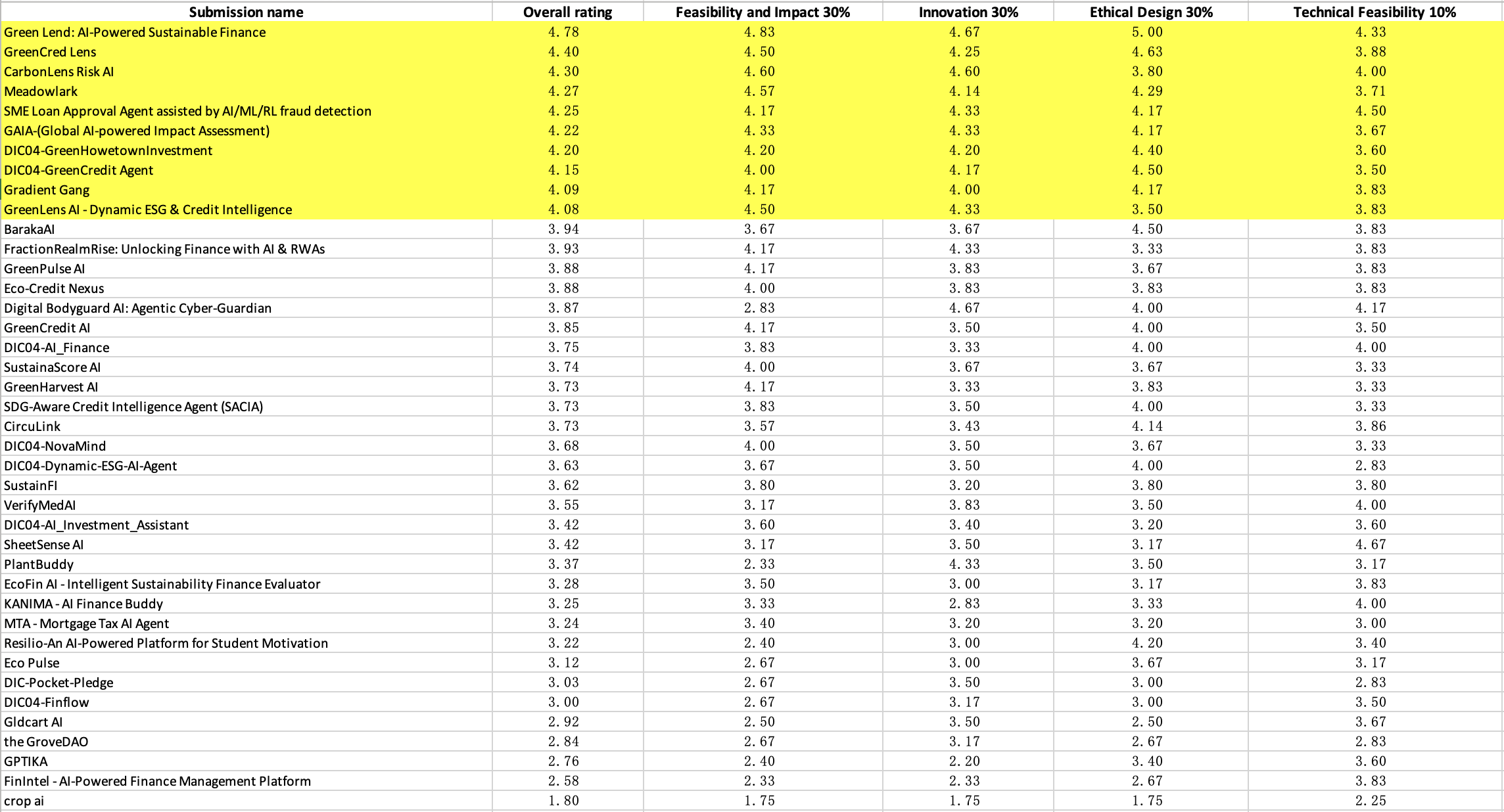
- Please check the Stage 2 guide below for the finalist list and details on mentorship and team expansion.
- https://docs.google.com/document/d/17OqNQYrBZdTk6cYINP8DXQyEjQk8-acL9N0NPW5MKj0/edit?tab=t.mymbdttipwaq
- Please complete your team contact information by the deadline of January 27 via the link below.
- https://docs.google.com/document/d/17OqNQYrBZdTk6cYINP8DXQyEjQk8-acL9N0NPW5MKj0/edit?tab=t.9pp9w9mjgd55#heading=h.k0kltvsctl5w
Guideline for Finance Track (not limits)
Click the link to learn more about the Education Track and Healthcare Track hosted by NYUSH: NYUSHDIC
Potential directions include:
1. Sustainable credit/risk analytics: Build AI-driven credit scoring or risk assessment models that integrate indicators from the United Nations' Sustainable Development Goals (SDGs) with a dual focus: advancing commercial value (e.g., enhancing stakeholder profits) and contributing to public goods by addressing at least one of the SDGs. These models aim to enable greener, fairer, and more profitable lending or investment decisions.
Guiding Question:
How can an AI-driven credit scoring or risk assessment system be developed to integrate SDG indicators—such as carbon emissions, social responsibility practices, and collaboration frameworks—alongside traditional financial indicators, to generate dynamic credit scores or risk ratings? How can this system empower financial institutions to simultaneously achieve commercial success by identifying green investment opportunities and contribute to global sustainability by avoiding high-risk, unsustainable projects?
2. Portfolio Advisors: Develop AI-powered investment advisory tools that enable individuals or institutions to build portfolios that balance financial returns with positive environmental and social impact.
Guiding Question:
How can an AI-powered investment advisory tool be designed to integrate real-time market data, and users’ financial goals (e.g., returns, risk preferences) while reaching the United Nations Sustainable Development Goals (e.g., reduced inequalities, sustainable cities and communities, climate actions) to generate personalized green investment portfolios? How can the tool dynamically adjust investment strategies and provide clear, visual recommendations to empower decision-making in balancing financial returns with sustainability?
3. Inclusion-oriented payments/credit rails: Develop AI-enabled FinTech platforms to expand access to credit and payment systems for underserved populations, such as rural communities or small enterprises.
Guiding Question:
How can an AI-driven payment or credit platform be developed to use non-traditional data (e.g., mobile payment records, local economic activity data) to build precise credit assessment models for underserved groups such as rural communities and small enterprises? How can the platform simplify user interactions (e.g., multilingual support, low-barrier design) and offer personalized financial services (e.g., microloans, installment payments) to help these groups access convenient financial services while reducing service costs for financial institutions?
How to establish your own topic:
1. Analyze Pain Points of Existing Financial Products
Product User Experience: Identify major obstacles faced by users when interacting with financial products, such as complicated processes or lack of transparency.
Sustainability Issues: Assess deficiencies in environmental and social responsibility aspects, such as support for green investments or carbon tracking.
Inclusiveness and Fairness: Discover gaps in serving underrepresented groups (e.g., rural communities, small businesses).
2. Solve Problems Using AI Agents
Data Collection and Analysis: Leverage AI to integrate traditional financial data with to generate dynamic insights.
Dynamic Decision Support: Develop tools for real-time credit scoring, risk assessment, or investment recommendations.
User Interaction and Visualization: Design simple and intuitive user interfaces that support multi-language and low-barrier access.
3. Utilize Resources and Offline Communication
Integrate Sponsor Resources: Combine AWS cloud and machine learning services, Caffeine AI’s blockchain technology, and GenOptima’s data engine for comprehensive technical support.
Field Trip Preparation: Understand the schedule and objectives of activities in advance, and create a participation plan.
Communicate with Experts: Discuss project feasibility and obtain professional advice from industry experts.
Requirement:
Participants are encouraged to design an AI Agent (or a system of agents) that addresses one of the potential directions outlined above. While we recommend exploring these topics, solutions related to other areas or innovative approaches to finance, sustainability, and AI are equally welcome.
The solution should demonstrate how integrating multiple financial and sustainability-focused capabilities can create a more impactful and versatile digital assistant for sustainable finance.
Your AI Agent is expected to incorporate capabilities such as gathering and analyzing SDG indicators, providing personalized investment recommendations, assessing credit risks, expanding financial inclusion, and offering dynamic, real-time insights. These capabilities should empower investors, financial institutions, underserved populations, and other stakeholders to make smarter, more sustainable, and better-informed financial decisions.
Requirements
Eligibility
- Each team consists of 2 to 4 participants, multidisciplinary team composition is strongly recommended.
- After advancing through the announcement stage, each qualified team can expand to 8-10 participants to facilitate the completion of large-scale projects.
Stage One Submission Requirements
- Proposal (in PDF format)
- Presentation Video (3-5 minutes, within 100MB)
- Project Prototype (optional, only for reference)
- After the submission window opens, DIC will release the official GitHub account, and contestants need to set it as a collaborator so the DIC committee can access the repo.
- Notice: Contestants in Finance Track MUST submit all their materials BOTH in Devpost via your own GitHub Repository URL and the official GitHub account.







Prizes
TBD
Devpost Achievements
Submitting to this hackathon could earn you:
Judges

Prof. Luyao Zhang
Assistant Professor of economics; Senior Research Scientist at the Digital Innovation Research Center at DKU

Dr. Dongping Liu
Senior Industry Business Development Manager Higher Education & Research Amazon Web Services

Prof. Mingchun Huang
Associate Professor of Data and Computation at DKU

Prof. Dongmian Zou
Assistant Professor of Data Science at DKU

Yizhou Yang
GenOptima

Julian Zhao
GenOptima
Judging Criteria
-
Feasibility and Impact 30%
Solutions must align with the theme "AI Agents Unlock Finance for Sustainability," addressing real-world financial problems tied to sustainability and SDGs, with clear societal or environmental benefits. -
Innovation 30%
Judges will assess originality and creativity in leveraging AI agents and FinTech, focusing on unique approaches that surpass conventional solutions in finance and sustainability. -
Ethical Design 30%
Solutions must prioritize fairness, inclusivity, and privacy, addressing ethical risks, accessibility, bias mitigation, and safeguarding user data effectively. -
Technical Feasibility 10%
Submissions should clearly present the core idea and its technical feasibility. Demos are optional, and evaluation will focus on the idea rather than the completeness of the technical implementation.
Questions? Email the hackathon manager
Tell your friends
This site is protected by reCAPTCHA and the Google Privacy Policy and Terms of Service apply.